
Capital Gains Tax on Shares and Mutual Funds for AY 2026-27: Latest Rules, Rates and Filing Guide

Table of Contents
- Key Takeaways
- What Changed in Capital Gains Tax for AY 2026-27?
- Capital Gains Holding Period for Shares and Mutual Funds
- Short-Term Capital Gains Tax on Equity Shares and Equity Mutual Funds
- Long-Term Capital Gains Tax on Equity Shares and Equity Mutual Funds
- Taxation of Debt and Hybrid Mutual Funds
- Set-Off and Carry Forward of Capital Losses
- Documents to Check Before Filing ITR
- Which ITR Form Should You Use for Capital Gains?
- How TaxSpanner Can Help
- Frequently Asked Questions
Key Takeaways
- The STCG tax rate on eligible listed equity shares and equity-oriented mutual funds under Section 111A has increased from 15% to 20%.
- The LTCG tax rate under Section 112A has increased from 10% to 12.5% on gains exceeding the annual exemption limit.
- The annual LTCG exemption under Section 112A has increased from ₹1 lakh to ₹1.25 lakh.
- Specified debt-oriented mutual funds acquired on or after 1 April 2023 are covered under Section 50AA, making gains taxable as deemed short-term capital gains, irrespective of the holding period.
- Indexation benefits are no longer available for capital gains covered under the revised provisions applicable from 23 July 2024.
- The revised tax rates and provisions apply when reporting capital gains for AY 2026-27, making it important to identify the correct asset type and applicable section before calculating tax.
What Changed in Capital Gains Tax for AY 2026-27?
Quick Answer
For AY 2026–27, Section 111A prescribes a 20% tax on eligible short-term capital gains arising from listed equity shares and equity-oriented mutual funds. Long-term capital gains (LTCG) are taxed at 12.5% under Section 112A on gains exceeding the ₹1.25 lakh annual exemption. A 12-month holding period applies for LTCG classification, and indexation benefits are not available.
If you sold shares or mutual funds during FY 2025-26, the capital gains will be reported in your Income Tax Return for AY 2026-27. It is important to apply the revised rules correctly because the capital gains tax on shares for AY 2026-27 is different from the older rates (applicable before July 2024) that many taxpayers may still remember.
The major changes include:
- Short-term capital gains tax on eligible listed equity shares and equity-oriented mutual funds increased from 15% to 20%.
- Long-term capital gains tax under Section 112A increased from 10% to 12.5%.
- The annual LTCG exemption limit under Section 112A increased from ₹1 lakh to ₹1.25 lakh.
- Specified debt-oriented mutual funds acquired on or after 1 April 2023 are covered by Section 50AA and do not get the normal long-term capital gains benefit.
These changes make it important to check the type of investment, purchase date, sale date, holding period and applicable section before calculating tax.
Capital Gains Holding Period for Shares and Mutual Funds
The first step in calculating capital gains tax is to identify whether the gain is short-term or long-term. This depends on the capital gains holding period.
For listed equity shares and equity-oriented mutual funds, the holding period for long-term classification is more than 12 months.
This means:
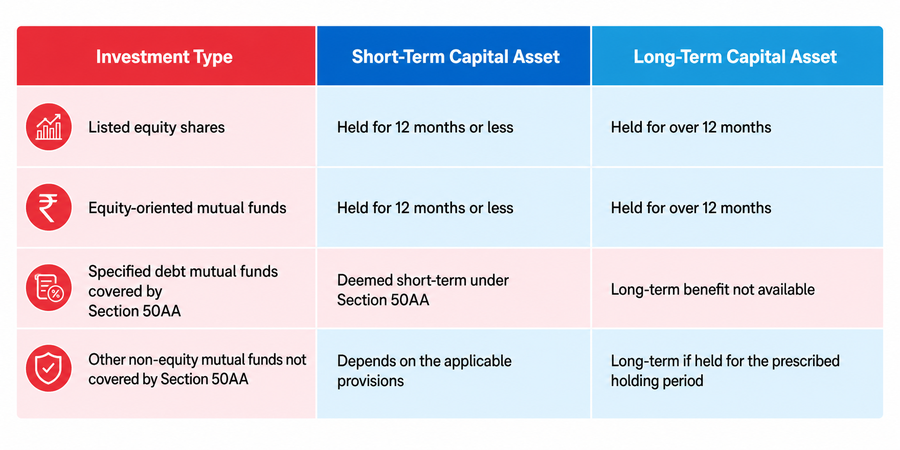
For equity investments, correct purchase and sale dates are very important. Verify these from your broker statement, demat account records, mutual fund statement or Consolidated Account Statement before filing your ITR.
Short-Term Capital Gains Tax on Equity Shares and Equity Mutual Funds
Short-term capital gains apply to profits earned on listed equity shares and equity-oriented mutual funds that are sold within 12 months of purchase.
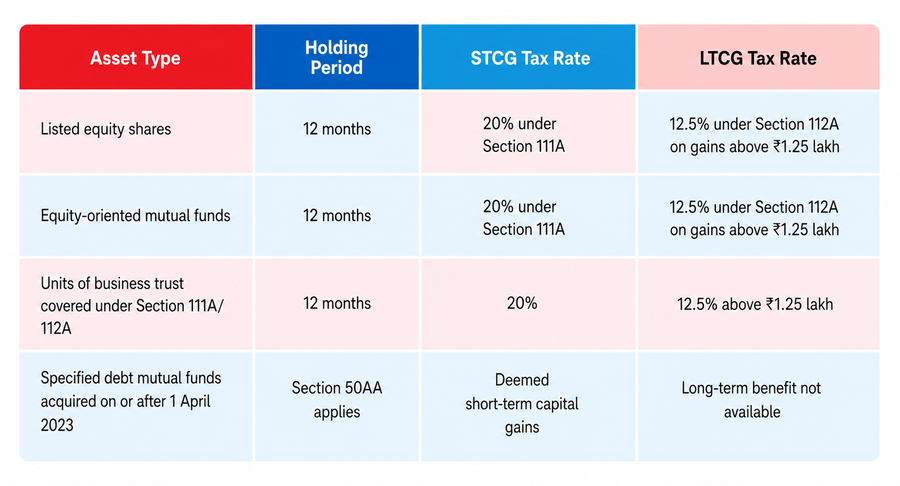
For AY 2026–27, short-term capital gains covered under Section 111A are taxed at 20%, up from the earlier rate of 15%. After adding 4% Health and Education Cess, the effective tax rate becomes 20.8%, subject to surcharge if the taxpayer's total income exceeds ₹50 lakh.
When does Section 111A apply?
Section 111A applies when the prescribed conditions are satisfied, including the transfer of a short-term capital asset being an equity share in a company, a unit of an equity-oriented fund or a unit of a business trust, and Securities Transaction Tax (STT) payment where required.
Important point for taxpayers
The STCG tax rate under Section 111A applies at a special rate. Regular deductions under Chapter VI-A, such as Section 80C or Section 80D, cannot be used to reduce tax payable on income taxed at special rates under Section 111A or Section 112A.
Therefore, even if your regular income is low, calculate tax separately on short-term capital gains covered under Section 111A.
Long-Term Capital Gains Tax on Equity Shares and Equity Mutual Funds
Long-term capital gains arise when listed equity shares or equity-oriented mutual funds are sold after being held for over 12 months. For AY 2026-27, long-term capital gains covered under Section 112A are taxed at 12.5% on the amount exceeding the annual exemption limit of ₹1.25 lakh.
Section 112A applies where the capital gains arise from transfer of a long-term capital asset being an equity share in a company, a unit of an equity-oriented fund or a unit of a business trust, subject to the prescribed conditions, including STT-related conditions.
Example
If your total eligible long-term capital gains from listed equity shares and equity-oriented mutual funds during FY 2025-26 are ₹2,00,000, the taxable LTCG will be:
₹2,00,000 – ₹1,25,000 = ₹75,000
Tax will apply at 12.5% on ₹75,000, plus applicable cess and surcharge, if any.
Important points
The ₹1.25 lakh exemption is an annual aggregate limit. It applies collectively to eligible long-term capital gains from listed equity shares, equity-oriented mutual funds and units of business trusts covered under Section 112A.
Indexation benefit is not available for such gains. Scrip-wise reporting is required in Schedule 112A where the reporting conditions for grandfathered listed equity shares or units acquired on or before 31 January 2018 are applicable. Verify your capital gains details before reporting them in your tax return.
Summary of Capital Gains Tax Rates for AY 2026-27
Taxation of Debt and Hybrid Mutual Funds
Debt and hybrid mutual funds are not taxed in the same way as equity-oriented mutual funds. The tax treatment depends mainly on the fund’s domestic equity exposure and the date of acquisition. Equity-oriented mutual funds continue to be taxed under the special capital gains provisions applicable to such schemes.
However, debt-oriented and specified hybrid mutual funds purchased on or after 1 April 2023 are taxed at the investor's applicable income tax slab, regardless of the holding period. In addition, from 23 July 2024, indexation benefits are no longer available for any asset.
Specified mutual funds under Section 50AA
For specified mutual funds acquired on or after 1 April 2023, gains are deemed to be short-term capital gains under Section 50AA. For this purpose, a specified mutual fund refers to a mutual fund where not more than 35% of its total proceeds is invested in equity shares of domestic companies, subject to the wording of Section 50AA.
This means that holding such a fund for a longer period does not make the gain eligible for normal long-term capital gains treatment or indexation benefit. The gain is deemed to be short-term capital gain and is taxed at the taxpayer’s applicable slab rate, unless a specific provision provides otherwise.
Section 50AA provides that gains from specified mutual fund units acquired on or after 1 April 2023 are deemed to be capital gains arising from the transfer of a short-term capital asset.
Hybrid mutual funds
Hybrid mutual funds require careful classification. If the fund qualifies as an equity-oriented mutual fund by maintaining the prescribed equity exposure, the equity taxation rules apply. If the fund does not qualify as an equity-oriented fund and is not covered by Section 50AA, the applicable holding period and tax treatment must be checked under the relevant provisions.
Before filing your ITR, review the scheme classification, mutual fund capital gain statement and fund category carefully. A wrong classification can lead to incorrect reporting of capital gains. Since the tax treatment varies across different categories of mutual funds, reviewing the scheme details and applicable provisions can help you calculate your tax liability correctly.
Set-Off and Carry Forward of Capital Losses
Capital losses can reduce your tax liability only if they are adjusted according to the rules under the Income-tax Act.
Set-off rules
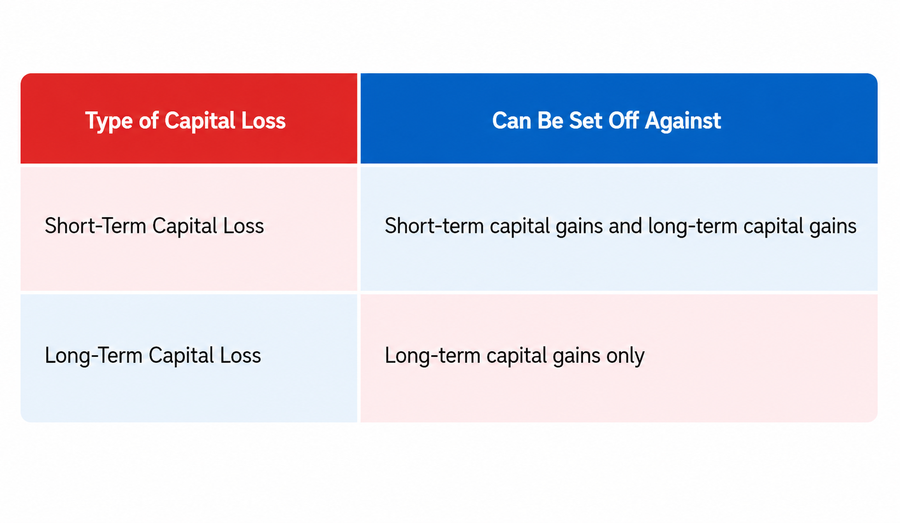
Capital losses cannot be set off against salary income, income from house property, business income or income from other sources. They can be adjusted only against eligible capital gains.
Carry forward of capital losses
If your capital losses are not fully set off during the financial year, you can carry the unadjusted losses forward for up to eight assessment years, subject to the applicable provisions.
Capital losses cannot be carried forward unless the return is filed within the prescribed due date under Section 139(1), except where specifically permitted by law.
Documents to Check Before Filing ITR
Before reporting capital gains in your Income Tax Return for AY 2026-27, check the following documents:
- Broker capital gains statement
- Demat account statement
- Mutual fund capital gains statement
- Consolidated Account Statement
- AIS
- TIS
- Form 26AS
- Dividend statement
- Bank statement for sale proceeds and investment transactions. You should also verify:
- Purchase date
- Sale date
- Purchase cost
- Sale value
- STT payment status
- Brokerage and eligible transfer expenses
- Grandfathering details, where applicable
- Capital losses eligible for set-off
- Correct ITR schedule for reporting capital gains
This reconciliation helps reduce mismatch notices and processing issues after filing.
Which ITR Form Should You Use for Capital Gains?
If you are reporting capital gains tax on shares for AY 2026-27 or gains from mutual funds, selecting the correct ITR form is essential for accurate tax filing.
ITR-1 can be used by a resident individual whose total income does not exceed ₹50 lakh and whose income is within the categories permitted for ITR-1. The Income Tax Department’s ITR-1 user manual includes long-term capital gains under Section 112A up to ₹1.25 lakh within the permitted scope of ITR-1.
However, ITR-1 cannot be used where the taxpayer has short-term capital gains or long-term capital gains under Section 112A exceeding ₹1.25 lakh. It also cannot be used where the taxpayer has business or professional income, income from more than two house properties, or other income categories not permitted in ITR-1.
In such cases, ITR-2 is commonly used where capital gains are reported along with salary, house property or income from other sources. ITR-3 applies where trading activity or any other income is taxable under the head ‘Profits and Gains of Business or Profession’.
How TaxSpanner Can Help
Capital gains reporting can become difficult when you have transactions across multiple brokers, mutual fund platforms or demat accounts. Errors may arise due to incorrect holding period, wrong classification of mutual funds, mismatch with AIS, or incorrect reporting under Section 111A and Section 112A.
Confirming capital gains calculations before filing ITR manually can be challenging. Miscalculating the capital gains holding period or overlooking the revised ₹1.25 lakh exemption can also affect your tax computation and reporting. TaxSpanner helps taxpayers file their ITR accurately by reviewing key tax documents and reconciling income details before filing.
With TaxSpanner, taxpayers can get support for:
- Capital gains computation
- Broker statement reconciliation
- Mutual fund capital gain reporting
- AIS, TIS and Form 26AS review
- Section 111A and Section 112A reporting
- Debt and hybrid mutual fund classification
- Set-off and carry forward of capital losses
- Selection of the correct ITR form
For investors, accurate reporting is not only about calculating tax correctly. It also helps avoid mismatch notices, defective return issues and future follow-up queries from the tax department. If you have sold shares or mutual funds during FY 2025-26, review your capital gains tax on shares for AY 2026-27 before filing your ITR to ensure accurate reporting and compliance.
Frequently Asked Questions
- What is the STCG tax rate on equity shares for AY 2026-27?
For eligible listed equity shares covered under Section 111A, short-term capital gains are taxed at 20% for AY 2026-27. Health and Education Cess and surcharge, if applicable, are charged separately.
2. What is the LTCG tax rate in 2026 for listed equity shares?
Long-term capital gains on eligible listed equity shares are taxed at 12.5% under Section 112A on gains exceeding the annual exemption limit of ₹1.25 lakh.
3. Does the ₹1.25 lakh exemption apply separately to shares and mutual funds?
No. The ₹1.25 lakh exemption is an aggregate annual limit for eligible long-term capital gains covered under Section 112A, including listed equity shares, equity-oriented mutual funds and units of business trusts.
4.Is indexation available on equity shares and equity mutual funds?
No. Indexation benefit is not available for long-term capital gains covered under Section 112A.
5. Is Section 87A rebate available on equity capital gains?
The Section 87A rebate does not reduce tax on special-rate capital gains such as STCG under Section 111A and LTCG under Section 112A. These gains remain taxable as per the applicable special rates.
6. How are SIP redemptions taxed?
Each SIP instalment is treated as a separate investment with its own purchase date. When units are redeemed, the First-In, First-Out (FIFO) method is applied, meaning the units purchased first are treated as being sold first. As a result, a single redemption may include both short-term and long-term capital gains, depending on the holding period of each instalment. The applicable tax is then calculated based on whether each redeemed unit qualifies as STCG or LTCG.
7. Can I claim Section 80C or 80D deduction against capital gains tax?
Chapter VI-A deductions such as Section 80C and Section 80D cannot be used to reduce tax on income taxable at special rates, including gains covered under Section 111A and Section 112A.
8. How are debt mutual funds taxed for AY 2026-27?
Specified debt-oriented mutual funds acquired on or after 1 April 2023 are covered under Section 50AA. Gains from such funds are deemed to be short-term capital gains, irrespective of the holding period.
9. Can short-term capital loss be set off against long-term capital gain?
Yes. Short-term capital loss can be set off against both short-term and long-term capital gains. If the loss cannot be fully adjusted in the same financial year, the unabsorbed amount can be carried forward for up to eight assessment years, provided the income tax return is filed within the due date.
10. Can long-term capital loss be set off against short-term capital gain?
No. A long-term capital loss can only be adjusted against long-term capital gains. Review your capital gains before filing your return to claim the set-off correctly.
11. Can capital losses be carried forward?
Yes. If your capital losses cannot be completely set off during the financial year, you can carry forward the unadjusted losses for up to eight assessment years, subject to the applicable conditions. However, the ITR must be filed within the prescribed due date to carry forward such losses, except where specifically permitted by law.
12. Which ITR form should I file if I have capital gains?
If taxpayers have capital gains tax on shares for AY 2026-27, eligible resident individuals can file ITR-1 (Sahaj) or ITR-4 (Sugam) as salaried professionals or those earning business income, respectively. Both forms work when long-term capital gains under Section 112A from listed equity shares or equity-oriented mutual funds do not exceed ₹1.25 lakh, there are no carried-forward capital losses, and all other eligibility conditions are satisfied.
ITR-1 or ITR-4 cannot be used where there are short-term capital gains, long-term capital gains under Section 112A exceeding ₹1.25 lakh, carried-forward capital losses, business income (unless otherwise eligible under ITR-4), or any other income not permitted under these forms. In such cases, ITR-2 or ITR-3 applies depending on the taxpayer's income profile.
13. Do I need to report grandfathered shares separately?
Yes. For eligible listed equity shares or units acquired on or before 31 January 2018, Schedule 112A reporting is required where the reporting conditions for grandfathering provisions apply.
14. Why should I reconcile AIS before filing ITR?
AIS may contain details of securities transactions, dividends, interest and other income. Reconciling AIS with broker statements, mutual fund reports and Form 26AS helps avoid mismatches and incorrect tax reporting.
15. What is the tax rate on dividends received from listed stocks or mutual funds?
Dividends are taxable as 'Income from Other Sources' and are generally taxed according to the investor's applicable income tax slab. TDS at 10% may apply if the total dividend received from a company or mutual fund exceeds ₹10,000 in a financial year. This threshold was increased from ₹5,000 with effect from FY 2025–26, subject to the applicable provisions.
16. Can TaxSpanner help with capital gains reporting?
Yes. TaxSpanner can help review capital gains statements, reconcile AIS and Form 26AS, classify gains correctly and file the appropriate ITR form for AY 2026-27.
Explore TaxSpanner's wide range of calculators for your tax planning and calculations!
View Tools & Calculators