
ESOP vs RSU vs ESPP Tax Rule Explained: All You Need to Know

Table of Contents
- Different Stages of Tax on Equity
- Employee Stock Option Plans (ESOPs) and Their Tax Blueprint
- Restricted Stock Units (RSUs) and How They’re Taxed
- Employee Stock Purchase Plans (ESPPs) and How They’re Taxed
- ESOP vs RSU vs ESPP Tax Comparison
- Choosing Between ESOPs, RSUs, and ESPPs
- Compliance, Foreign Asset Reporting, and ITR Disclosures
- Planning for Wealth Maximisation and Tax Efficiency
- How Zaggle’s Tax Solution Can Simplify Filing
- Common Tax Planning Mistakes to Avoid
- Frequently Asked Questions
Key Takeaways
- ESOPs are taxed as a perquisite when exercised, RSUs at vesting, and ESPPs when shares are purchased through the plan.
- All three equity compensation plans are taxed twice—first as Salary Income (perquisite) and later as Capital Gains when the shares are sold.
- The Fair Market Value (FMV) used to calculate the perquisite generally becomes the cost of acquisition for capital gains.
- Employees of eligible startups under Section 80-IAC may defer ESOP perquisite tax until the earliest of 48 months, resignation, or sale of the shares.
- Listed Indian shares qualify for 12.5% LTCG after 12 months and 20% STCG within 12 months, subject to the applicable provisions.
- Foreign and unlisted shares generally qualify for 12.5% LTCG after 24 months, while gains on shares held for 24 months or less are generally taxed at the applicable slab rates.
- Employees holding foreign ESOPs, RSUs or ESPPs may need to file ITR-2/ITR-3, disclose holdings in Schedule FA, and claim foreign tax credit, where applicable.
ESOP vs RSU vs ESPP Tax Rule Explained: All You Need to Know
Quick Answer
ESOPs, RSUs and ESPPs are all taxed in two stages in India. The first tax is charged as a perquisite under Salary Income when you acquire the shares—at exercise for ESOPs, vesting for RSUs and purchase for ESPPs. The second tax applies when you sell the shares, where capital gains tax depends on the holding period, type of shares and applicable tax provisions.
Start-ups and MNCs today offer significant stock options that can hold value if and when the company succeeds. However, share price volatility and the way this type of equity is treated in Income Tax Returns (ITRs) can lead to complexity. That’s why knowing the ESOP vs RSU vs ESPP tax treatment matters. A small action can lead to a large tax liability.
The main issue is simple: paper wealth is not real cash. To manage this, you need to understand the difference between ESOP and RSU along with ESPP taxation rules in India. Each works differently. Some give you shares directly, some give you options, and others use salary deductions.
In India, stock options tax follows a basic rule: you pay tax twice. First, at the time of receiving or exercising shares (perquisite tax). Second, when you sell them (capital gains tax). This applies to tax on restricted stock units as well.
For example, under IT rules related to ESOP taxation in India in 2026, you may end up paying taxes up to 30% even before you sell your shares. Equity can help you build wealth—but only if you understand the taxes and plan ahead.
Different Stages of Tax on Equity
To understand ESOP vs RSU vs ESPP tax structures, know the key stages of how equity works. The Income Tax Department does not treat equity as one simple asset. It looks at different stages where tax may apply.
Grant Date
This is when your company offers shares or options. There is no tax at this stage because you don’t own anything yet. Since employees do not receive ownership of the shares at the grant stage, no tax generally arises merely because the options or units have been granted.
Vesting Date and Vesting Period
The vesting period is the time you need to stay with the company or meet certain goals to earn the shares. The vesting date is when the shares actually become yours. Tax impact is different here.
- RSUs: Tax applies at vesting
- ESOPs: No tax at vesting; tax applies at exercise
- ESPPs: Tax generally applies when shares are purchased/allotted at a discount, not at vesting
Exercise Date and Exercise Price (Strike Price)
- This applies only to ESOPs
- The exercise price is the fixed price at which you can buy shares
- The exercise date is when you choose to buy them
Fair Market Value (FMV)
FMV is the value of the share used for tax calculation.
- For Indian listed companies: Closing stock price on the relevant date
- For unlisted companies: Value decided by a merchant banker
- For foreign companies: Converted into INR using SBI exchange rates
The key idea is simple: tax is charged when you actually gain value (like at vesting or exercise) and again when you sell the shares.
Employee Stock Option Plans (ESOPs) and Their Tax Blueprint
Employee Stock Option Plans remain a foundational element of startup compensation. Under an ESOP, employees receive the option to purchase company shares at a predetermined exercise price after satisfying the applicable vesting conditions. This triggers a unique two-stage tax treatment.
Merely receiving ESOPs does not create a tax liability. Tax generally arises only when the employee exercises the options and acquires the shares. If the employee chooses not to exercise the vested options within the permitted exercise period, no tax is ordinarily payable on those options.
Stage 1: Perquisite Tax (Exercise Stage)
The moment you decide to purchase your options on the Exercise Date, the tax department treats the financial benefit as a ‘perquisite’ (part of your taxable salary). The formula is structured as:
Perquisite Value = FMV on Exercise Date - Exercise Price X Number of Shares
The perquisite value is added to your salary income, and your employer is required to deduct tax at source (TDS) in accordance with the applicable provisions of the Income Tax Act.
Stage 2: Capital Gains Tax (Sale Stage)
When you eventually sell these shares, you enter Stage 2. For capital gains purposes, the holding period generally begins from the date the shares are acquired pursuant to the exercise of the options.
If the sale of ESOP shares results in a capital loss instead of a gain, the loss may be eligible for set-off and carry forward in accordance with the applicable provisions of the Income Tax Act, subject to filing the income tax return within the prescribed timelines.
Special Startup Provisions (Section 192(1C) Deferral)
Recognising that startup employees often face an unfair cash crunch, Indian tax law provides a major relief under Section 192(1C). This is for employees of eligible startups covered under Section 80-IAC. Instead of paying perquisite tax immediately at exercise, the tax liability is deferred to the earliest of the following milestones:
- 48 months (4 years) from the end of the relevant Assessment Year in which the ESOPs were exercised
- The date the employee terminates their employment with the company
- The actual date of the sale of those shares
Unlisted Equity
If you work for an unlisted startup that is not DPIIT-certified, you must pay the perquisite tax immediately at exercise. This poses a financial risk: you will owe money to the government on illiquid paper wealth before any IPO or corporate buyback event occurs. If shares later sell at a lower value, the employee may realise a capital loss. But that usually does not fully offset the earlier salary/perquisite taxation problem.
Restricted Stock Units (RSUs) and How They’re Taxed
Unlike ESOPs, RSUs do not require employees to pay an exercise or strike price. Instead, the company allots shares to the employee once the prescribed vesting conditions, such as continued employment or performance milestones, are satisfied.
Stage 1: Perquisite Tax (Vesting Stage)
Since RSUs do not involve an exercise stage, the allotment of vested shares generally triggers perquisite taxation. The perquisite value is determined based on the Fair Market Value (FMV) of the shares on the vesting date and is taxed as salary income.
Where the RSUs relate to a foreign company, the Fair Market Value (FMV) is generally converted into Indian Rupees using the applicable exchange rate prescribed under the tax rules for determining the taxable perquisite value.
Since the perquisite value is taxed as salary income, employers generally deduct the applicable tax at source (TDS). Many employers use a ‘Sell-to-Cover’ arrangement, under which a portion of the vested shares is sold to recover the employee's tax liability, while the remaining shares are credited to the employee. Depending on the employer's policy, other methods such as upfront tax payment or same-day sale may also be available.
Stage 2: Capital Gains Tax (Sale Stage)
When you sell your RSU holdings, capital gains tax becomes applicable. For employees holding RSUs issued by foreign companies, the tax treatment differs from that applicable to eligible listed Indian equity shares. The ₹1.25 lakh long-term capital gains exemption under Section 112A applies only to eligible listed equity shares and equity-oriented mutual funds that satisfy these prescribed conditions:
- Securities Transaction Tax (STT) must be paid on both purchase and sale of equity shares
- The securities must qualify as long-term capital assets
- The securities should be held for more than 12 months
- No deduction under Chapter VI-A can be claimed against such LTCG
Foreign RSUs (shares not listed on an Indian stock exchange) do not qualify for this exemption. The Fair Market Value (FMV) adopted for perquisite taxation becomes the cost of acquisition for capital gains purposes. Any appreciation above this value is taxed in accordance with the capital gains provisions applicable to foreign shares. You pay tax on any profits at a 12.5% (plus applicable surcharge and cess) long-term capital gains rate if sold after 24 months and STCG as per slab rates if held for less than 24 months.
Employee Stock Purchase Plans (ESPPs) and How They’re Taxed
An Employee Stock Purchase Plan (ESPP) differs from an ESOP or RSU because it allows employees to purchase company shares at a discounted price through payroll deductions. Depending on the terms of the plan, the discount may be up to 15% of the Fair Market Value (FMV) of the shares on the purchase date.
Stage 1: Perquisite Tax (Purchase Stage)
Although employees contribute towards the purchase price through payroll deductions, the difference between the Fair Market Value (FMV) of the shares on the purchase date and the price paid by the employee is treated as a taxable perquisite. The perquisite value is calculated as follows:
Perquisite Value = (FMV on Purchase Date − Purchase Price) × Number of Shares
The perquisite value is treated as salary income, and the employer generally deducts tax at source (TDS) on this amount through payroll. Depending on the employer's plan, the tax liability may be recovered through payroll deductions or by selling a portion of the shares acquired under the plan. Employees should verify the mechanism followed by their employer before participating in an ESPP.
Stage 2: Capital Gains Tax (Sale Stage)
Once the shares are acquired under the ESPP, they become capital assets for tax purposes. The holding period for capital gains generally begins from the date of acquisition. When the shares are sold, capital gains are generally computed by taking the Fair Market Value (FMV) that was considered for perquisite taxation as the cost of acquisition.
In certain cases, capital gains may be computed differently due to:
- Corporate actions, such as stock splits, bonus issues, mergers, or demergers, which may require the cost of acquisition to be adjusted under the provisions of Section 49 of the Income-tax Act
- Cross-border tax implications, where relief under a Double Taxation Avoidance Agreement (DTAA) or foreign tax credit provisions may affect the tax treatment of ESOP/ESPP income and subsequent capital gains, among others.
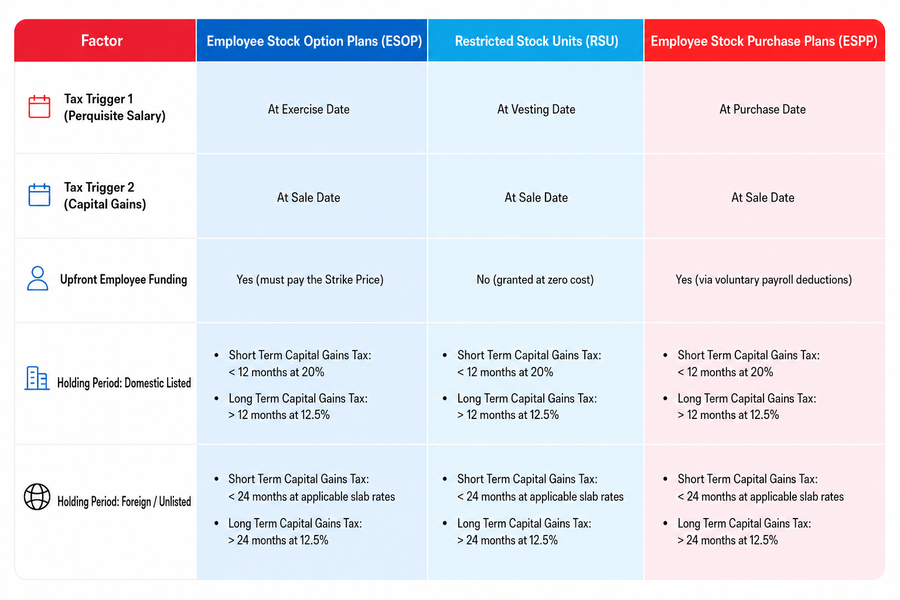
ESOP vs RSU vs ESPP Tax Comparison (2026 Rules)
Navigating the timelines and tax rates across all three types of equity becomes easier when you can compare them. Here’s a table that outlines the most important parameters to remembers about how ESOPS, RSUs, and ESPPs are taxed:
Example:
- ESOP: Rahul receives 100 ESOPs with an exercise price of ₹500 per share. On the exercise date, the Fair Market Value (FMV) is ₹6,500 per share. The difference of ₹6,000 per share (₹6,500 − ₹500) is treated as a taxable perquisite under Salary Income. If Rahul later sells the shares, capital gains are calculated using the FMV on the exercise date (₹6,500) as the cost of acquisition. This follows the tax treatment prescribed for ESOPs under the Income-tax Act.
- RSU: Priya receives 100 RSUs that vest when the FMV is ₹800 per share. Since no exercise price is payable, the FMV of ₹800 per share is treated as a taxable perquisite. If she later sells the shares at ₹950 per share, capital gains are calculated only on the appreciation from ₹800 to ₹950.
- ESPP: Neha purchases 100 shares under her company's ESPP at ₹850 per share when the FMV is ₹1,000 per share. The ₹150 discount per share is treated as a taxable perquisite. If she subsequently sells the shares at ₹1,150 per share, capital gains are computed using the FMV of ₹1,000 as the cost of acquisition.
In all three cases, the employee is generally taxed twice. First when the shares are acquired (through exercise, vesting or purchase) as a perquisite under Salary Income, and again when the shares are sold, where capital gains are computed using the FMV adopted for perquisite taxation as the cost of acquisition.
Choosing Between ESOPs, RSUs, and ESPs
The right form of equity compensation depends on your financial goals, cash flow and risk appetite. ESOPs may offer a significant upside if the company’s valuation grows, but they require employees to pay the exercise price and, in many cases, the applicable perquisite tax before any sale of equity. This may create cash flow challenges, particularly for employees of unlisted companies.
RSUs provide greater certainty because employees receive shares once the vesting conditions are met without paying an exercise price. However, they trigger perquisite taxation immediately upon vesting, irrespective of whether the shares are sold. This creates a tax liability before the employee realises any gains.
ESPPs allow employees to acquire company shares at a discount through payroll deductions. While the discount is taxable as a perquisite, employees benefit from purchasing shares below the prevailing market price. Employees should evaluate the tax implications, liquidity requirements and long-term investment objectives before participating in any equity compensation plan.
Compliance, Foreign Asset Reporting, and ITR Disclosures
Filing taxes with equity compensation requires careful attention to detail. If you own RSUs or ESPPs in a foreign parent corporation, your tax obligations go far beyond standard salary reporting.
- Schedule FA (Foreign Assets): If you hold foreign shares or are required to disclose foreign assets, you cannot file ITR-1. Instead, you must file ITR-2 or ITR-3, as applicable, and complete Schedule FA wherever required. Schedule FA requires the disclosure of specified foreign assets, including foreign equity holdings, foreign bank accounts, and other reportable foreign financial interests, wherever applicable.
- Risk of Black Money Act Penalties: Do not make the mistake of assuming that because your company executed a ‘Sell-to-Cover’ TDS withholding, your compliance is complete. Failure to disclose reportable foreign assets may attract penalties under the Black Money (Undisclosed Foreign Income and Assets) and Imposition of Tax Act, 2015. Depending on the applicable provisions, penalties of up to ₹10 lakh may be levied in certain cases.
- Double Taxation Avoidance Agreements (DTAA): Where foreign taxes have been paid on eligible foreign income, taxpayers may claim relief under the applicable Double Taxation Avoidance Agreement (DTAA) or under Sections 90, 90A, or 91, subject to the prescribed conditions. Taxpayers claiming a Foreign Tax Credit (FTC) are required to furnish Form 67 in accordance with Rule 128 and the applicable filing requirements.
- Tax Collection at Source (TCS) on ESPPs: Money transferred abroad programmatically via payroll for foreign ESPP plans falls under the Liberalised Remittance Scheme (LRS). This makes it subject to standard TCS regulations once it crosses prescribed annual thresholds.
Taxpayers should reconcile the information reported in their Form 26AS and Annual Information Statement (AIS) with their own records before filing the return to identify and correct any reporting discrepancies.
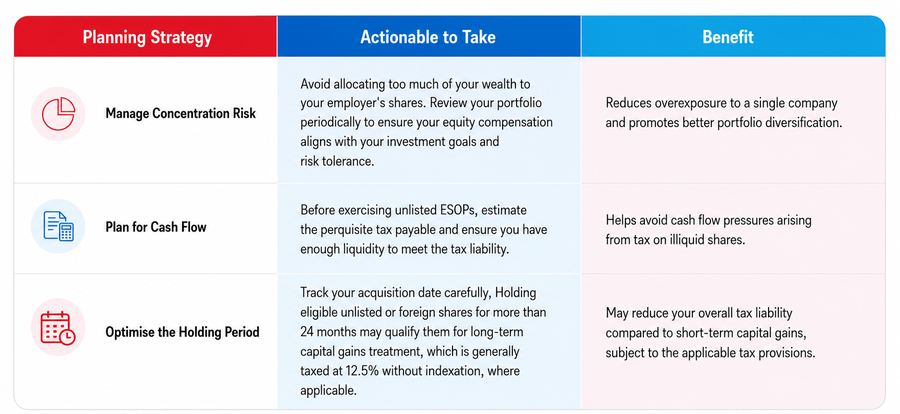
Planning for Wealth Maximisation and Tax Efficiency
Managing equity compensation effectively requires a clear financial strategy. To maximise your returns while minimising your tax liabilities, consider the following table:
How Zaggle’s Tax Solution Can Simplify Filing
Managing the tax implications of ESOPs, RSUs and ESPPs can become challenging, especially when you have equity compensation from multiple employers, foreign shareholdings or cross-border tax obligations. Errors in perquisite valuation, capital gains computation, Schedule FA disclosures or foreign tax credit claims can lead to inaccurate reporting and unnecessary issues.
Zaggle tax solution helps simplify both employee and employer tax compliance by reviewing key tax documents, reconciling income details and supporting accurate income tax return filing.
With it, you can get support for:
- ESOP, RSU and ESPP tax computation
- Perquisite valuation and capital gains calculation
- Schedule FA and foreign asset disclosures
- Form 16, AIS, TIS and Form 26AS reconciliation
- Foreign Tax Credit (FTC) and DTAA-related reporting
- Selection of the correct ITR form
- Set-off and carry forward of eligible capital losses
- Expert-assisted tax filing support
For organisations, Zaggle’s tax solution also helps streamline employee tax compliance through automated tax optimisation, payroll integration and audit-ready tax workflows. For employees, it simplifies reporting across different stages of equity compensation, helping reduce filing errors and improve overall tax compliance.
Common Tax Planning Mistakes to Avoid
Employees receiving ESOPs, RSUs or ESPPs often focus on the value of their shares but overlook associated tax obligations. Some common mistakes include:
- Ignoring the perquisite tax payable before selling the shares
- Assuming that the exercise price is the cost of acquisition instead of the Fair Market Value used for perquisite taxation
- Forgetting to disclose foreign shares in Schedule FA, where applicable
- Missing the prescribed holding period when planning the sale of shares
- Failing to reconcile Form 16, Form 26AS, AIS and brokerage statements before filing the income tax return
Reviewing these aspects before filing can help minimise reporting errors and improve overall tax compliance.
Frequently Asked Questions
- What is the primary difference between ESOP and RSU structures in corporate compensation?
The primary difference between ESOP and RSU lies in how the equity is acquired. An ESOP gives you the option (the right, but not the obligation) to buy company shares at a predetermined exercise price after a vesting period. An RSU, or restricted stock units, represents an outright promise to grant you actual shares at zero cost once specific performance or tenure milestones are reached.
2. How does the overall ESOP vs RSU vs ESPP tax framework operate in India?
The overarching ESOP vs RSU vs ESPP tax framework in India operates as a two-stage mechanism. Stage 1 occurs when you physically acquire the shares (at exercise, vesting, or purchase), where the benefit is taxed as a perquisite under salary income. Stage 2 occurs when you eventually sell those shares, which triggers capital gains tax based on your holding period.
3. What is the RSU vs ESOP difference regarding upfront funding?
The fundamental RSU vs ESOP difference regarding funding is that RSUs require zero upfront cash from the employee. Shares are delivered for free upon vesting. Conversely, ESOPs require you to pay an exercise price out of pocket to convert your options into actual stock.
4. How is ESOP taxed at exercise under Indian tax law?
To understand how ESOP is taxed at exercise, look at the Fair Market Value (FMV). On the day you exercise your options, the difference between the prevailing FMV of the shares and your predetermined exercise price is calculated as a perquisite. This perquisite value is added directly to your taxable salary income and is subject to standard slab rates via payroll TDS.
5. What are the primary rules governing RSU vs ESOP taxation in India for employees of multinational companies?
When evaluating RSU vs ESOP taxation in India, the core distinction is the taxable trigger event. RSUs generally trigger perquisite taxation when the vested shares are allotted to the employee, whereas ESOPs trigger perquisite taxation when the employee exercises the options. ESOPs do not trigger tax at vesting; instead, they trigger perquisite tax later when the employee actively chooses to exercise the options.
6. Is there any stock option tax in India that requires you to pay on the exact day options are granted?
No. The grant of ESOPs, RSUs, or ESPPs is generally not a taxable event in India. Tax liability typically arises at the prescribed stage of vesting, exercise, or purchase, depending on the nature of the equity compensation.
7. What are the updated parameters for ESOP taxation in India in 2026 for startup employees?
Under the rules for ESOP taxation in India in 2026, employees of eligible startups covered under Section 80-IAC enjoy a tax-deferral benefit. Instead of paying perquisite tax immediately at exercise, the tax liability is deferred until the earliest of three events. This applies to 4 years (48 months) from the end of the relevant assessment year, upon the employee's resignation or departure from the company, or upon the sale of the shares.
8. What is the primary ESPP tax implication India outlines for discounted share programs?
The primary ESPP tax implication in India relates to the employee discount. When shares are purchased using programmatic payroll deductions, the difference between the public FMV on the purchase date and your discounted purchase price is treated as perquisite salary income and taxed at your regular slab rates.
9. How are restricted stock units (RSUs) taxed when you sell the shares?
The tax rate on restricted stock units on a subsequent sale depends on where the company is listed. For RSUs issued by Indian listed companies, if you hold the shares for 12 months or less after acquisition, the gains are generally treated as STCG. If the shares are held for more than 12 months, they generally qualify as LTCG and are taxed at 12.5% above the applicable exemption limit under Section 112A, subject to the applicable provisions of the Income-tax Act.
For foreign/US RSUs, if you hold the shares for 24 months or less after acquisition, the gains are generally treated as STCG and taxed at the applicable income tax slab rates. If the shares are held for more than 24 months, they generally qualify as LTCG and are taxed at 12.5% without indexation, subject to the applicable provisions of the Income-tax Act.
10. Why does RSU taxation in India differ between domestic listed companies and foreign parents for capital gains?
RSU taxation in India differs because foreign shares are not listed on recognised Indian stock exchanges and are generally not subject to Securities Transaction Tax (STT). Consequently, domestic listed equity shares are eligible for the capital gains provisions applicable to listed securities, including the ₹1.25 lakh LTCG exemption, subject to the prescribed conditions.
In contrast, foreign RSUs generally require a 24-month holding period to qualify as long-term capital assets, and the applicable long-term capital gains provisions apply without the exemption available for eligible listed Indian equity shares.
11. How is the Cost of Acquisition determined when calculating capital gains across ESOP vs RSU vs ESPP tax filings?
Across all ESOP vs RSU vs ESPP tax calculations, the Cost of Acquisition (CoA) for capital gains is the Fair Market Value (FMV) that was previously utilised to calculate your perquisite tax. You only pay capital gains tax on the incremental appreciation that occurs after you legally acquire the shares.
12. Which ITR form is mandatory if I have vested shares for a US tech company under RSU vs ESOP taxation in India rules?
If you hold shares in a foreign entity, as per RSU vs ESOP taxation in India rules you are legally prohibited from filing ITR-1 (Sahaj). You must file ITR-2 (for salaried people) or ITR-3 if you have business income, as they include the mandatory schedules for foreign assets and capital gains.
13. How do I avoid double taxation on foreign ESPP tax implication India events using the DTAA?
If the country where the shares are held (e.g., the US) withholds tax on your equity gains or dividends, you can utilise the Double Taxation Avoidance Agreement (DTAA). To prevent a double ESPP tax implication hit, you must file Form 67 on or before the tax filing deadline to claim a Foreign Tax Credit (FTC) against your Indian tax liability.
14. Are dividends received from foreign RSU or ESPP allocations taxable in India?
Yes. Any dividends paid out on foreign shares are fully taxable in India for Resident and Ordinarily Resident (ROR) individuals. You must declare them under ‘Income from Other Sources’ (Schedule OS) and pay tax at your applicable progressive slab rate though you can claim relief as per DTAA.
Explore TaxSpanner's wide range of calculators for your tax planning and calculations!
View Tools & Calculators