Modernising Salary Structures for the New Labour Code Changes in India: Why it’s Important

During a routine audit, the HR team at a mid-sized Bengaluru IT firm uncovered a gap. Their allowance-heavy CTC design did not meet the 50% wage requirement. Basic pay was only 35% of total pay. This exposed the company to penalties and fines under the New Labour Code that may apply in cases of non-payment of minimum wage or pay structure violations.
It also risked employee pushback if deductions reduced take-home pay. Without clear visibility into PF, gratuity, and tax impact, costs rose unexpectedly. When payroll expenses increase unexpectedly, it puts pressure on budgets close to the financial year-end.
This scenario highlights issues of salary non-compliance in India. Outdated pay structures can expose businesses to legal and financial wage rule challenges. This challenge tends to be common across Indian industries, where many salary structures favour flexibility over statutory alignment, with a Basic Pay ratio of about 25-40% of CTC.
The New Wage Code took effect in November 2025 under the Labour Code reforms. It requires wages, defined as basic pay, dearness allowance, and retaining allowance, to make up at least 50% of total remuneration for statutory purposes.
Organisations with allowance-heavy CTCs must thus redesign pay structures before 1st April 2026 to avoid compliance and payroll disruptions. Non-compliance increases regulatory, audit, and litigation risks and can raise statutory contribution obligations. It can also reduce employee net pay, making thoughtful, tax-aligned restructuring essential.
A compliant CTC redesign, on the other hand, can improve cost efficiency through better alignment of statutory contributions and tax planning.
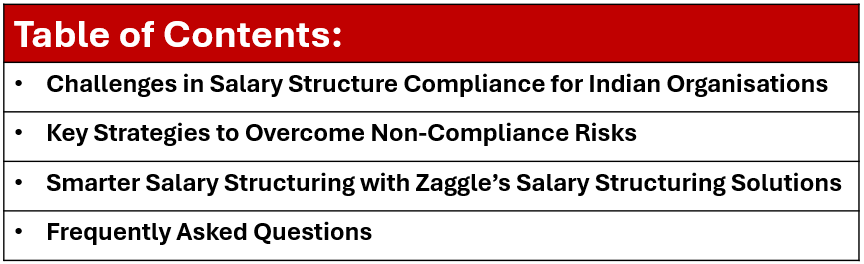
Challenges in Salary Structure Compliance for Indian Organisations
For organisations in India, compliant salary structures under the Labour Code go beyond payroll. They also require alignment with national wage standards across a diverse workforce.
Businesses often grapple with varying employee expectations, tax regimes, and operational scales. However, HR must prioritise enterprise-wide compliance to mitigate Labour Code fines/penalties or, in more serious cases, imprisonment.
Without unified visibility into salary components and statutory impact, pay structures become fragmented. This drives inefficiencies, raises costs, and increases exposure to salary non-compliance in India. These challenges appear in several critical areas:
- Fragmented Wage Visibility
Salary data spread across departments makes it difficult to verify the 50% wage rule. This raises the risk of compliance gaps and fines of up to ₹50,000 for first offences and, in case of a second offence, up to ₹1,00,000 and/or with imprisonment of up to 3 months (Section 54 of the Code on Wages, 2019). Reports show real-time compliance tracking can cut audit prep time by up to 40%. This is because continuous monitoring helps identify and fix gaps early.
- Inconsistent Contribution Tracking
Monitoring PF, gratuity, and NPS obligations gets complex when exclusions exceed the 50% limit, since a portion of the excess is also added to wages. Such structures can sharply increase liabilities. Poor tracking may lead to a buildup of backdated payments. In non-compliant salary structures, statutory costs can increase due to higher wage bases and retrospective adjustments.
- Communication and Alignment Gaps
Gaps between HR policy and employee understanding often cause dissatisfaction. This is especially true when take-home pay appears lower after the New Wage code or poor restructuring. Poor communication further erodes trust and can increase attrition.
- Risk Exposure from Tax Regime Variations
Fluctuating tax regime choices add complexity, especially when flexi-benefits aren’t optimised. This increases exposure to both Labour Code non-compliance and tax-related penalties.
- Prolonged and Misaligned Redesign Processes
Balancing compliance with cost control strains resources and extends timelines. It often leads to rigid pay structures that don’t meet employee needs, especially in multi-location firms.
Key Strategies to Overcome Non-Compliance Risks
A New Wage Code–aligned salary structure focuses on compliant CTC design and optimised social security contributions. It also leverages tax alignment and flexible benefits to support employee take-home pay. Centralised data and streamlined processes turn compliance challenges into efficiency gains.
Start by assessing current CTC structures against the 50% wage mandate. This ensures accurate contribution calculations and reduces exposure to Labour Code penalties. Clear accountability is key. HR leads the redesign process, while finance assesses contribution and cost impact to safeguard accuracy.
Compliance is strengthened through category-specific allowance limits. This allows targeted optimisation and highlights cost-saving flexi-benefits. Annual reviews aligned with tax regimes help reduce wage rule risks. Mandatory audits and automated checks create verifiable data trails. This grounds decisions in reliable evidence.
Multi-level reviews route changes smoothly from HR to leadership, speeding up approval cycles. Real-time tracking of PF, gratuity, and NPS shows issues early and helps teams make quick adjustments. Complementing these, consolidated reports and reminders drive timely optimisations for contributions and benefits.
These integrated strategies move organisations toward balanced, compliant pay structures. They also reduce salary non-compliance exposure in India and strengthen resilience.
Smarter Salary Structuring with Zaggle’s Salary Structuring Solutions
With the New Wage Code now in effect, salary structuring is no longer just an HR decision — it is a statutory compliance requirement for organisations in India. Consolidated impact assessments help reduce violations under the New Labour Code and prevent heavy fines/penalties wage rule risks while improving payroll visibility.
With Zaggle’s salary structuring solutions, HR teams can move from fragmented, tax-inefficient pay structures to wage code–ready tax-efficient salary designs that balance compliance, cost control, and employee experience. Using analytics and expert guidance, organisations gain clarity on PF, gratuity, and tax impact before changes go live.
Beyond compliance, Zaggle helps simplify HR operations and employee communication through:
- Up to 70% reduction in tax-related employee queries, easing HR workload
- Seamless integration with existing payroll processes, minimising disruption
- Compliance-ready documentation and reports for audit preparedness
- Zero cost for HR teams to evaluate and onboard, enabling faster adoption
Zaggle also supports flexi-benefit optimisation aligned with the new tax regime, helping organisations protect employee take-home pay where possible while maintaining cost neutrality.
Our services cover wage code–compliant salary structure redesign, assessing PF, gratuity, and NPS impact. We also support payroll-ready implementation and clear HR and employee communication.
To get started, share your current salary structure for a confidential review. You can then join a complimentary discussion with our salary and wage code experts. This will help you understand the impact, find cost efficiencies, and plan a compliant transition.
Frequently Asked Questions
What are Labour Code penalties under the new wage code, and why do they matter for salary non-compliance exposure in India?
Labour Code penalties include fines of up to ₹50,000 for first-time wage underpayment or pay structure violations. Repeat offences can lead to fines of up to ₹1,00,000 and up to three months of imprisonment. These rules enforce the 50% wage mandate, protecting workers while exposing non-compliant companies to financial and legal risk.
What is the new Labour Code for basic salary?
Under India’s new wage rules, wages are defined for statutory calculations and allowances exceeding 50% of total compensation are added back to wages. Wages include basic pay, dearness allowance, retention allowance and specified statutory components. Employers may offer allowances, but these cannot exceed the remaining 50%.
If they do, the excess amount is treated as wages, increasing the base for Provident Fund, gratuity, and other statutory benefits. This framework promotes standardised pay structures and strengthens long-term employee social security coverage.
How does the new wage definition affect Provident Fund and gratuity calculations?
Basic pay, dearness allowance and retention allowance must now make up at least 50% of total pay. This can increase the base used to calculate Provident Fund and gratuity for many employees. PF contributions from both employers and employees may increase, and future gratuity payouts can rise. This improves long-term benefits but may lower monthly take-home pay due to higher deductions.
Can employers still offer allowances under the new Labour Code wage rules?
Yes, employers can continue offering allowances such as HRA and special pay. However, these allowances cannot make up more than 50% of total compensation. If allowances cross the 50% limit, the excess is treated as wages. This increases the base for PF, gratuity, and other statutory benefit calculations.
What are the key strategies for implementing compliance and avoiding Labour Code penalties in salary structuring?
Successful strategies to avoid Labour Code penalties involve:
- Preparation through CTC analysis
- Optimising long-term contributions
- Leveraging data for tax-aligned flexi-benefits
- Timing redesigns before fiscal deadlines
- Incorporating employee feedback
- Focusing on balanced compliance and efficiency
- These efforts secure compliant structures while minimising costs
Explore TaxSpanner's wide range of calculators for your tax planning and calculations!
View Tools & Calculators