
NRI ITR Filing in 2026: A Complete Guide


Table of Contents
- Understanding NRI Residential Status: Who Qualifies as an NRI?
- Important Forms and Documents for NRI ITR Filing in 2026
- How Zaggle’s Tax Solution Helps You File Correctly
- Frequently Asked Questions
Key Takeaways:
- Your NRI residential status under Section 6 of the Income-tax Act determines whether you are taxed as an NR, RNOR or resident and what income you must report.
- NRIs are taxed only on Indian-sourced income, while foreign income is generally not taxable in India.
- Most NRIs file ITR-2, while those with business or professional income generally need to file ITR-3.
- Reviewing Form 16, Form 16A, Form 26AS, AIS and TIS before filing helps reconcile TDS and minimise reporting errors.
- Accurate reporting of your residential status, taxable income and TDS details helps avoid notices, penalties and delayed processing of refunds.
All You Need to Know About NRI ITR Filing in 2026: Qualification, Forms, and Due Dates
Quick Answer
NRI ITR filing in 2026 depends on your residential status under Section 6 of the Income-tax Act. NRIs are generally taxed only on Indian-sourced income, while foreign income is generally not taxable in India. Most NRIs file ITR-2, whereas those with business or professional income generally file ITR-3.
If you work abroad or have moved out of India, understanding your tax obligations is essential for NRI ITR filing in 2026. The Income Tax Act, 1961, establishes clear rules for how NRIs are taxed. As an NRI, you’re liable to tax only on Indian-sourced income such as salary, rental income from Indian property, or capital gains from Indian investments, while foreign income remains outside India’s tax jurisdiction.
These benefits come with important compliance requirements. Choosing the wrong residential status, filing the incorrect ITR form, or failing to report taxable Indian income accurately can lead to notices, delayed refunds, penalties, or excess tax payments.
Understanding the applicable rules, complying with TDS provisions, maintaining proper documentation, and claiming relief under a Double Taxation Avoidance Agreement (DTAA), where applicable, can help you avoid these issues. It also ensures accurate NRI ITR filing in 2026 and helps you prevent excess tax payments and claim the reliefs or refunds you're entitled to.
Understanding NRI Residential Status: Who Qualifies as an NRI?
Your NRI residential status isn’t determined by where you live, but by how many days you spend in India during a financial year. Section 6 of the Income Tax Act, 1961, provides specific criteria to classify whether you’re a resident or non-resident for tax purposes.
How Residential Status Is Determined
You’ll be classified as a Resident in India if you meet either of these conditions:
- You stay in India for 182 days or more during the financial year
- You stay in India for 60 days or more in the current year and 365 days or more across the 4 immediately preceding years
If you do not satisfy either condition (subject to applicable exceptions), you are treated as a Non-Resident (NR) for income tax purposes. Your understanding of NRI residential status for tax purposes depends primarily on these conditions and the applicable exceptions under Section 6 of the Income Tax Act. This classification determines what income you must report and how much tax you owe.
If you qualify as a resident, you may further be classified as Resident but Not Ordinarily Resident (RNOR) based on your residential history under the Income Tax Act. Understanding NR or RNOR status is important because an RNOR is taxed differently from an ordinary resident, and foreign income is generally taxable in India only in limited circumstances.
An individual is generally treated as a Resident but Not Ordinarily Resident (RNOR) if they qualify as a resident and satisfy either of the following conditions:
- Non-resident in 9 out of 10 preceding years, or
- Stayed in India for ≤ 729 days in the last 7 years
- Indian citizen / PIO visiting India earns over ₹15 lakhs, stays 120–181 days in that year, and 365+ days in the last 4 years
Certain deemed residents under Section 6(1A) are also treated as RNOR, subject to the applicable provisions of the Income-tax Act.
Important Exceptions to the 60-Day Rule
The Income Tax Department recognises certain circumstances that modify the 60-day threshold. If you’re an Indian citizen or person of Indian origin visiting India, or if you’re an Indian citizen who left India during the year for employment abroad or as a crew member, the 60-day limit increases to 182 days. This provides relief to individuals working abroad who visit India briefly.
Additionally, the Finance Act, 2020, introduced a stricter rule for high-income earners. If you’re an Indian citizen or person of Indian origin earning a total income exceeding ₹15 lakh (excluding foreign-sourced income), the 60-day threshold increases to 120 days. This means the 60-day condition is replaced with 120 days for such individuals, provided the other residential conditions under Section 6 are also satisfied. This may affect your residential status, the ITR form you qualify for, and your overall tax obligations.
Special Rule for High-Income Citizens
From Assessment Year 2021-22 onwards, there’s an additional provision under Section 6(1A). If you’re an Indian citizen earning total income exceeding ₹15 lakh (other than foreign-sourced income) and you’re not liable to pay tax in any other country by reason of your domicile, residence or any other similar criteria, you’re deemed to be Resident but Not Ordinarily Resident (RNOR) in India under Section 6(1A).
In such cases, the standard duration-based criteria do not determine your residential status. This provision prevents tax avoidance and ensures high-income individuals filing from abroad still maintain Indian tax compliance.
Taxable Income for NRIs in India
NRIs are generally taxed only on income that accrues, arises, or is received in India. This typically includes:
- Salary earned for services rendered in India
- Rental income from property situated in India
- Interest earned on NRO accounts and other taxable Indian investments
- Capital gains from the transfer of capital assets situated in India
Foreign income is generally not taxable in India for NRIs. However, different tax rules may apply if your residential status changes to RNOR or ROR.
Important Forms and Documents for NRI ITR Filing in 2026
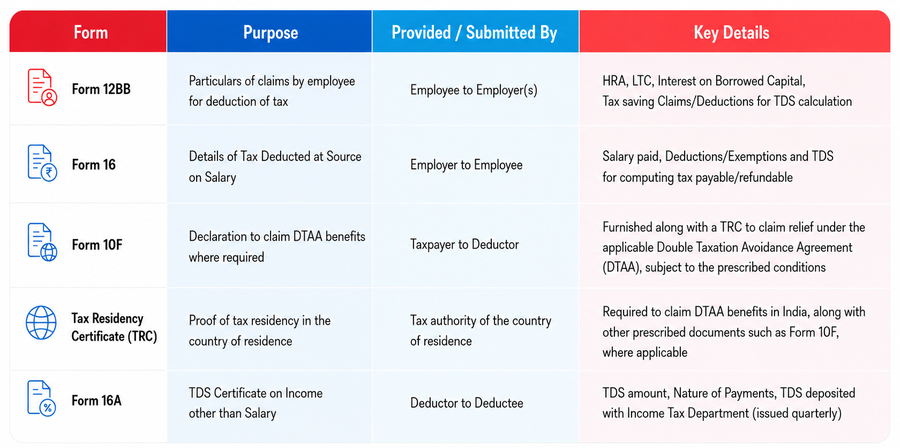
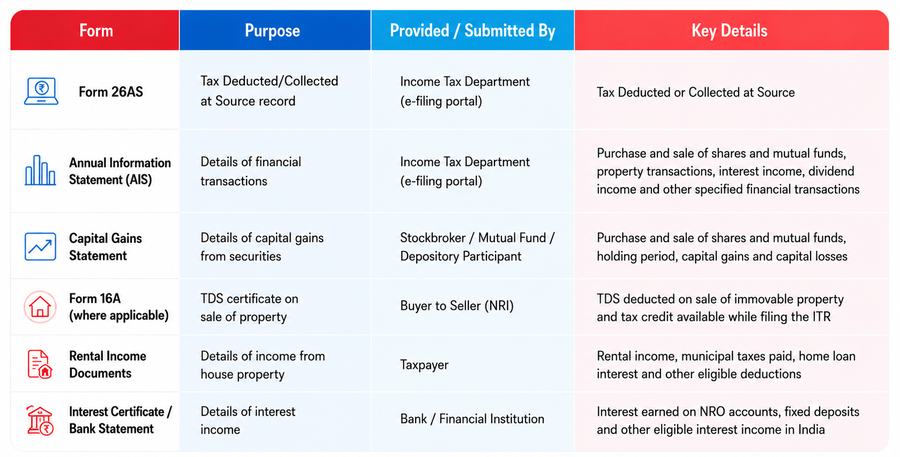
Depending on your sources of income, residential status and filing requirements, you may need to refer to various forms, certificates and statements while preparing your return. These documents help you provide complete information to the Income Tax Department and ensure compliance with TDS provisions and documentation requirements.
How Zaggle’s Tax Solutions Help NRIs File Correctly
NRI ITR filing in 2026 can become complex. Apart from determining residential status and identifying taxable Indian income, one needs to reconcile TDS across multiple income sources, and comply with foreign income reporting requirements.
Selecting the correct ITR form and claiming relief under a Double Taxation Avoidance Agreement (DTAA), where applicable, is another task. In addition, errors in reporting or form selection can result in notices, delays or excess tax payments.
Zaggle’s tax solution simplifies the filing process by helping you review key tax documents, reconcile income details and prepare an accurate return before submission. With Zaggle, you can get support for:
- Determining NR or RNOR residential status
- Selection of the correct ITR form for NRI filing
- Form 16, Form 16A, AIS, TIS and Form 26AS reconciliation
- TDS verification across multiple Indian income sources
- Rental income and capital gains reporting
- DTAA and Foreign Tax Credit (FTC) reporting
- Expert-assisted ITR filing support
For NRIs, accurate tax reporting is about more than filing a return on time. It also helps reduce the risk of TDS mismatches, defective returns, notices and unnecessary follow-up from the Income Tax Department.
Missing the applicable NRI ITR filing deadline can lead to late fees, interest, and delays in processing your return. Most individual taxpayers must file by 31 July 2026, while taxpayers subject to audit generally have until 31 October 2026.
Reviewing your records before filing can help ensure an accurate and compliant return, whether you have salary, rental income, capital gains, or other Indian-sourced income.
Frequently Asked Questions
1. When are you considered a Non-Resident Indian (NRI)?
Understanding NRI residential status for tax purposes starts with the conditions prescribed under Section 6 of the Income-tax Act. An individual is treated as a Non-Resident (NR) if they do not satisfy either of the following conditions for being a resident:
- Staying in India for 182 days or more during the financial year
- Staying in India for 60 days or more during the financial year and 365 days or more during the four immediately preceding financial years, subject to the applicable 120-day and 182-day exceptions
2. What is the deadline for NRI ITR filing in 2026?
For most NRIs, the due date for filing the ITR for AY 2026–27 is 31 July 2026, unless extended by the Government. If the NRI is required to get their accounts audited under the Income-tax Act, the due date is generally 31 October 2026. In rare cases where transfer pricing provisions apply and a report in Form 3CEB is required under Section 92E, the due date is generally 30 November 2026.
3. What income is taxable for NRIs in India?
NRI income taxable in India includes salary, rental income from Indian property, capital gains on Indian asset sales, and interest from Indian bank accounts. However, agricultural income and specified tax-free investments like certain bonds remain exempt.
4. What is the capital gains taxation for NRIs?
Capital gains arising from the transfer of assets situated in India, such as shares, mutual funds, or immovable property, are generally taxable in India. The applicable tax treatment depends on the type of asset, its holding period, and the relevant provisions of the Income-tax Act.
5. Are fixed deposits for NRIs tax-free?
FDs for NROs are taxable at applicable tax slab rates for NRIs. Interest earned on eligible NRE fixed deposits is generally exempt from tax in India, while interest on NRO fixed deposits is taxable. If an NRI invests in an eligible 5-year tax-saving fixed deposit, the investment may qualify for a deduction under Section 80C only if the old tax regime is applicable. However, the interest earned on the deposit remains taxable in accordance with the applicable provisions.
6. Can NRIs choose between the old and new tax regime?
Yes. Eligible NRIs can generally choose between the old and new tax regimes, subject to the provisions of the Income-tax Act. NRIs without business or professional income can generally exercise this choice while filing their ITR before the due date. Different rules apply where business or professional income is involved.
7. Must taxes be deducted from payments made to NRIs?
Yes. Specified payments to NRIs, such as rent, professional fees and fees for technical services, are subject to TDS by the payer. The person making the payment must obtain a TAN to deduct and deposit the tax. The deductor then issues Form 16A as the TDS certificate, which NRIs can use to claim credit for the tax deducted while filing their ITR.
8. Can NRIs file ITR online in India?
Yes, Non-Resident Indians can file their ITRs online. The process is entirely digital and done through the same official e-filing portal.
9. Do NRIs need to file an ITR if tax has already been deducted at source (TDS)?
Yes. TDS does not automatically remove your filing obligation. If your total income exceeds the applicable basic exemption limit or you are otherwise required to file an income tax return under the Income-tax Act, you must file your ITR even if tax has already been deducted. Filing also allows you to claim any eligible refund.
10. Which ITR form should an NRI use for salary and rental income?
Most NRIs earning salary, pension, rental income or capital gains, without business or professional income, generally file ITR-2. If you have income from a business or profession, including proprietary business income, you generally need to file ITR-3.
11. Can NRIs claim benefits under a Double Taxation Avoidance Agreement (DTAA)?
Yes. If your income is taxed in both India and another country, you may be eligible to claim relief under the applicable Double Taxation Avoidance Agreement (DTAA). The extent of the relief depends on the provisions of the relevant tax treaty. You may also need documents such as a Tax Residency Certificate (TRC), Form 10F and other prescribed declarations to claim the relief, wherever applicable.
12. What documents should NRIs keep ready before filing their ITR?
NRIs should keep documents such as Form 16, Form 16A, Form 26AS, the Annual Information Statement (AIS), the Taxpayer Information Summary (TIS), bank statements, capital gains statements, and details of rental income or other Indian-sourced income. Reviewing these documents before filing helps reduce reporting errors and supports accurate tax compliance.
Explore TaxSpanner's wide range of calculators for your tax planning and calculations!
View Tools & Calculators