
Why Filing an ITR Is More Than a Tax Requirement

Table of Contents
- Top Benefits of Filing ITR
- How ITR Helps You Get a Loan
- How ITR Supports Visa Applications
- Why Filing an ITR Can Help with Scholarships and Education Loans
- How Zaggle's Tax Solution Can Help
- Frequently Asked Questions
Key Takeaways
- Filing an Income Tax Return (ITR) does more than help you meet your tax obligations. It also creates an official record of your income and financial history.
- A history of filing ITRs consistently can strengthen a loan application as it helps lenders assess your income stability and capacity for repayment.
- Many visa application centers, education loan providers and scholarship programmes rely on ITRs to verify an applicant's financial position.
- Filing your ITR also helps you claim eligible tax refunds and carry forward certain losses, subject to the applicable provisions.
- Even if your income is below the taxable limit, filing an ITR can offer practical benefits by improving your financial credibility.
Why Filing an ITR Matters Beyond Tax Compliance
Quick Answer
Filing an Income Tax Return (ITR) is not only about reporting your income and paying taxes. It also creates an official record of your financial history that can support loan applications, visa processing, scholarships, tax refunds and other financial requirements.
Many taxpayers view ITR filing as an annual compliance requirement that ends once the return is submitted. However, the importance of filing an income tax return extends far beyond this. It influences your access to loans, visas, scholarships, and other financial opportunities.
Taxpayers often understand the importance of filing an income tax return only when they are asked to submit their previous ITRs for a home loan, visa application, or education loan. By then, it is too late to create a consistent financial record.
Banks and other institutions like embassies often look at your financial history over several years. Filing ITR on a regular basis can enhance your financial credibility, apart from helping you get tax refunds, if any. It also helps in carrying forward certain losses. By understanding the benefits of filing an ITR, you will be well-prepared to take advantage of significant financial opportunities rather than hunting for documents when the need arises.
Key Benefits of Filing an Income Tax Return
Meeting your tax obligations is just one aspect of filing your ITR. It also creates an official financial record that can support various financial and administrative requirements. From claiming tax refunds to strengthening your financial profile, the benefits of filing ITR extend well beyond tax compliance.
- ITR as Income Proof
A filed ITR is a commonly accepted document for income proof. It is a recognised record of your annual income and taxes paid.
One of the benefits of an income tax return for salaried employees is that it complements documents such as salary slips and Form 16. Thus providing an official record of annual income and taxes paid.
ITR can be a vital document for income verification for self-employed professionals, freelancers, and consultants when dealing with banks, financial institutions and other organisations.
It may also be accepted as proof of address for certain official and financial purposes, like passport applications and loan applications.
- Claiming Tax Refunds
If you have paid excess tax through TDS or advance tax, you can claim an eligible refund by filing an ITR.
This can happen when the amount of tax deducted during the financial year is more than the actual tax liability. Even if your income is below the taxable limit, you may still have to file an ITR to claim a refund of excess TDS deducted from salary or other eligible income.
- Carrying Forward Eligible Losses
You are eligible to carry forward eligible losses by filing your ITR within the prescribed time, as per the relevant provisions of the Income-tax Act.
For example, you can offset losses from shares and mutual funds against eligible future income and therefore reduce your future tax liability.
- Building a Consistent Financial Record
Regular filing of ITR creates a documented financial history that is a reflection of your income during a period of several years.
This record can be used in loan applications, visa processing, etc., where proof of financial standing is required. It also ensures that the necessary financial documents are always available when required.
If your income is below the basic exemption limit, filing an ITR may not always be mandatory. However, it can still offer these benefits.
How Does ITR Help You Get a Loan?
When you apply for a loan, lenders assess your income stability and ability to repay. One of the key benefits of filing ITR is that it strengthens your loan application. ITR is useful because it serves as proof of income over a period of a few years, which helps lenders to assess your financial standing along with your current income.
Banks and financial institutions frequently ask for ITRs for the last two to three years in case of home loans, business loans and other credit products. The exact requirement depends on the type of loan and the lender.
For the self-employed, freelancers, consultants and business owners who may not have regular salary slips, this ITR proof is particularly important. It assists lenders in evaluating financial stability.
Can Filing an ITR Improve Loan Eligibility?
Submitting an ITR does not guarantee loan approval. Lenders also check your credit score, repayment history, income and earnings, other liabilities, and your overall financial health.
But regularity in ITR filing history is a sign of financial responsibility and documented income.
This can make your loan application stronger and may make you more eligible for a higher loan amount or better loan terms. Without an ITR, it can be harder to prove your income, especially if you don’t have other ways to show what you earn.
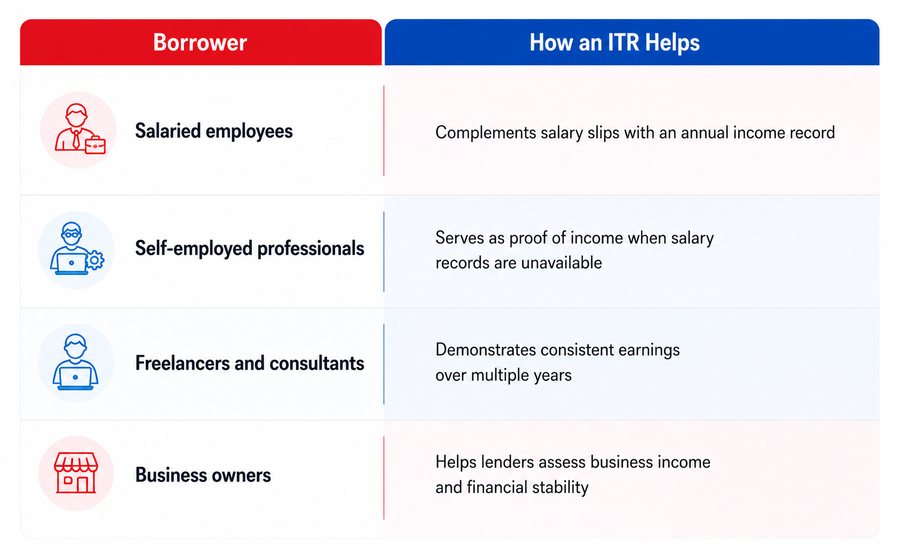
How Do Different Borrowers Benefit from Filing an ITR?
The value of an ITR for loan approval depends on the profile of a borrower. The following table explains how different borrowers can benefit from filing ITRs regularly:
How Does ITR Help in Visa Applications?
The need to submit an ITR for visa applications may seem strange. However, it is required by many countries to assess finances as it affects an applicant’s ability to support their travel or stay abroad. Since the ITR is a government-accepted record of the income that you declare, it is considered proof of financial stability.
An ITR is not necessary for every visa application, but it can strengthen your financial standing. It can help prove your capacity to meet travel/education and living costs. Applicants are required to submit the ITRs of the last two to three years (depending upon the type of visa and destination country) and other supporting documents.
An ITR can be used to support visa applications for different types of visas, such as:
- Tourist visas: Evidence of sufficient funds to support your expenses
- Business visas: Help in establishing your financial status when you travel for business
- Student visas: Used as financial proof to support the full duration of education through the ITRs of parents or guardians
Having an ITR can strengthen your application, but it does not guarantee that your visa application will be approved. Visa authorities also consider the purpose of travel, supporting documents and the immigration requirements before arriving at a decision.
Benefits of Filing ITR for Education Loans and Scholarships
Many educational institutions, scholarship providers and lenders use ITRs to verify an applicant's finances. You may submit them when applying for education loans or for scholarships and financial aid.
Here’s how an ITR comes in to play for education-related requirements:
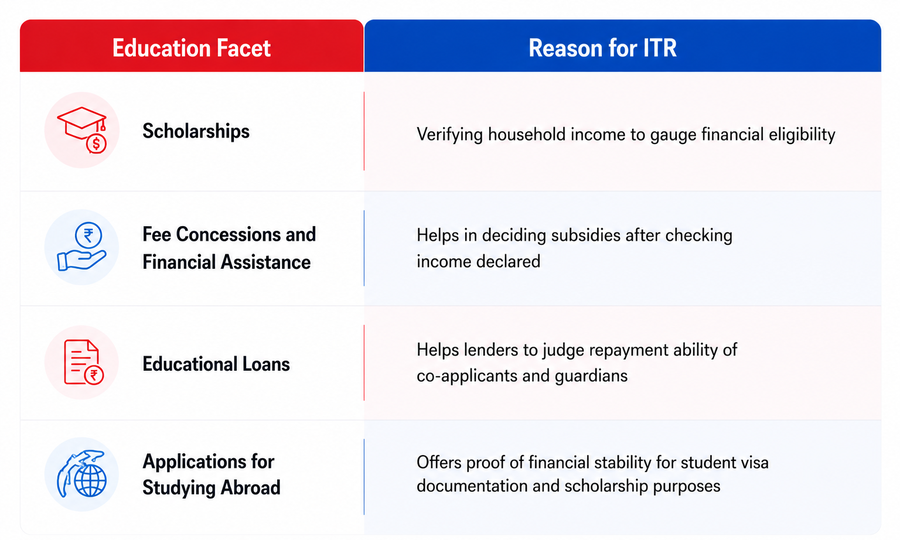
While submitting an ITR is mandatory for availing of a scholarship or education loan, institutions check other documents too. Academic performance, income, repayment capacity and other eligibility criteria come into play before you get approval.
How Zaggle's Tax Solution Can Help
Whether you're filing your ITR to meet tax obligations or to support future financial goals, accuracy is essential. Errors in reporting income, overlooking eligible refunds or submitting incomplete information can lead to processing delays and unnecessary follow-ups.
Zaggle's tax solution helps simplify the filing process by supporting taxpayers through every stage. From reviewing key tax documents to ensuring that the correct information is reported, the platform helps reduce the chances of errors and makes filing more convenient.
With Zaggle's tax solution, taxpayers can get support for:
- Reviewing income and tax documents before filing
- Filing accurate Income Tax Returns
- Claiming eligible tax refunds
- Selecting the appropriate ITR form
- Resolving discrepancies before submission
- Filing returns within the prescribed due date
A correctly filed ITR not only helps you stay compliant but also allows you to enjoy the long-term benefits of filing an ITR, including stronger financial credibility.
Frequently Asked Questions
1.What are the advantages of filing an ITR?
Claiming tax refunds, creating proof of income, carrying forward eligible losses, and creating a documented financial record are some of the benefits of filing an ITR. It also helps when you are applying for loans, visas, scholarships, or other financial needs.
2. What is the role of ITR in the loan process?
An ITR is used by lenders to check your income, financial stability, and loan repayment capacity. While lenders also aspects like your credit score and financial history, a consistent filing record can bolster your loan application.
3. Is ITR mandatory for a home loan?
No, ITR is not necessary for all home loans. But some lenders ask you to produce your ITRs of the last 2-3 years to verify your income and assess your repayment capacity. Business owners, professionals or freelancers in particular may be asked to submit ITRs in lieu of salary statements.
4. Is it mandatory to file an ITR to get a loan?
No, but this requirement depends on the lender and type of loan. ITRs are mandatory for higher-value home and business loans. If there is no ITR, verifying an applicant’s income might be a little more difficult. This may affect the approval process.
5. Why do I need ITR for visa applications?
Many countries ask for ITRs from the applicants as proof of financial stability along with other documents. Every visa application does not require an ITR. The requirement for it depends on the type of visa and the country.
6. Why should I file an ITR if my income is below the taxable limit?
If your income exceeds the basic exemption limit of ₹4 lakh, filing an ITR is mandatory. Even if your income is below the taxable limit, you can avail a lot of financial benefits by filing an ITR. It can help you claim tax refunds that you are eligible for. In addition, it helps you build a financial history and get better chances of successfully meeting future loan or visa application requirements.
7. How does an ITR help self-employed professionals and freelancers?
The ITR benefits for self-employed individuals and freelancers include creating a government-recognised proof of income and establishing a documented financial history. It also supports loan applications when regular salary slips are unavailable and helps demonstrate financial credibility.
8. Is ITR a proof of income?
Yes, an ITR is widely accepted as proof of income. It is useful for educational institutions, financial institutions, and other such institutions as it provides a government-recognised record of your reported income and taxes.
9. How does ITR help in getting a loan?
An ITR acts as proof of your income and financial stability. Lenders often ask for ITRs from the last two to three years to assess your repayment capacity, especially for home, business and high-value loans. A consistent ITR filing history can strengthen your loan application, although approval also depends on factors such as your credit score and overall financial profile.
10. Can filing an ITR help with scholarships and education loans?
Yes, an ITR can be of help in the application process for education loans and scholarships. Many schools, scholarship providers, and lenders require the ITRs of parents or guardians for the purpose of assessing household income and determining eligibility.
11. Which papers do I have to keep after filing my ITR?
After filing your ITR, it is advisable to keep all your tax filing records intact. This includes the ITR you have filed and the acknowledgement. Also record the computation of income, Form 16 or Form 16A (if applicable), Form 26AS, AIS, TIS, bank statements, investment proofs, and other supporting documents. These records may prove useful should there be any future financial obligations and tax enquiries.
Explore TaxSpanner's wide range of calculators for your tax planning and calculations!
View Tools & Calculators