How to Create a Compliant Salary Structure in India as per Labour Law: A Guide for 2026

With the New Wage Code effective from 21st November 2025, organisations across India are reworking how they design compensation. A salary structure in India that was compliant a year ago may now fall short of labour law salary rules. Full alignment is expected before the start of FY 2026–27 on 1st April 2026.
Many employers waited for Budget 2026 to confirm timelines or definitions. Since the Budget introduced no changes to wage definitions, the position is now clear. Wage Code compliance is mandatory and time-bound.
At the same time, organisations still have an opportunity to redesign salary structures in a way that balances statutory compliance, employer cost, and employee take-home. This requires structured planning rather than last-minute changes.
Why Salary Structuring Matters Before April 1, 2026—Even Though It Isn’t Mandatory
Salary structuring has become a strategic necessity, not because it is legally mandatory, but due to regulatory certainty and practical timelines.
The New Wage Code has been effective since November 2025, redefining wages and impacting salary composition and statutory costs. Its financial impact aligns with the new financial year starting April 2026, when payroll and compensation frameworks are typically reset. Budget 2026 provided no extensions or transitional relief, making early planning critical.
Delaying salary restructuring increases the risk of rushed decisions, higher statutory outgo, and employee dissatisfaction. Acting early allows organisations to optimise structures and communicate clearly—balancing Labour Code compliance, employee take-home, and cost discipline with minimal disruption.
What the New Wage Code Means for Salary Structure in India
The New Wage Code changes directly impact how salary structures in India must be designed going forward.
- Standardised wage definition under labour law salary rules
The Wage Code introduces a uniform definition of wages across labour laws. Earlier, organisations relied heavily on allowances to structure pay.
Under the revised framework, wages must form a minimum portion of total remuneration. This limits the flexibility to keep Basic Pay low.
- Practical impact on salary composition
The impact becomes clearer when salary structures are compared before and after Wage Code alignment.
 1. Impact of New Wage Code on salary composition and statutory costs:
 2. Impact on statutory compliances:
While CTC remains unchanged, statutory outflows increase due to higher wages. Employees gain higher retirement benefits, but the monthly cash flow may be reduced if structures are not redesigned.
 3. Impact on in hand salary without restructuring:
The most immediate effect of the New Wage Code is seen in employee take home when salary structures are not optimised.
This reduction occurs despite unchanged CTC. Higher Provident Fund and gratuity contributions can reduce your organisation’s immediate cash flow.
Understanding the 50% Wage Rule and its Impact on CTC and Statutory Costs
The 50% wage rule is central to the Wage Code. It requires wages to form at least half of the total remuneration.
- What the rule actually requires
The rule does not mandate a flat increase in Basic Pay alone. It requires a review of the entire compensation framework. Wages and allowances must be balanced within the prescribed limits.
- Why this increases statutory costs
Higher wages increase the base for Provident Fund and gratuity. This raises employer contributions and long-term liabilities. Without redesign, organisations absorb higher costs while employees experience lower take-home pay.
This makes the 50% wage rule a financial planning issue rather than a payroll adjustment.
How to Design a Compliant and Tax-Efficient Salary Structure in India for FY 2026–27
Now that compliance requirements are clear, the focus shifts to optimisation. The objective is to meet labour law salary rules while protecting employee take-home and maintaining cost neutrality.
- Role of flexi benefits and tax optimisation
Tax efficiency remains possible under both tax regimes. The Old Tax Regime allows a wider range of flexi benefits. The New Tax Regime still permits select exemptions.
When flexi benefits are structured correctly, organisations can offset the cash flow impact of higher statutory contributions.
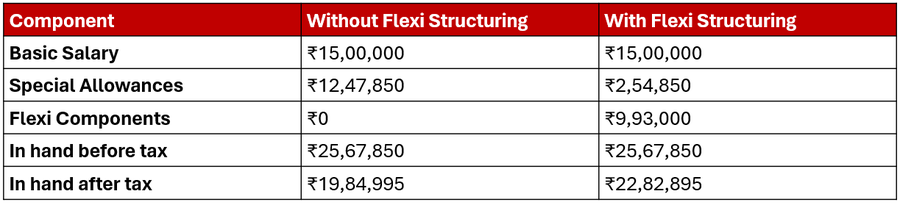 Impact of smart salary structuring under the New Wage Code:
The illustration shows that with the right approach, a compliant salary structure in India can still improve employee take home. Compared to a non-optimised structure, the net gain can be as high as ₹2,97,900 through better tax efficiency and design.
- Planning for rollout and approvals
HR and finance teams must review salary structures across employee groups. Payroll systems should be tested for accurate calculations. Clear documentation and phased communication can help reduce employee queries and implementation risk.
How Zaggle Supports Wage Code Ready Salary Structuring
Execution is often the most complex part of Wage Code compliance. Organisations require tools that combine compliance, tax optimisation, and operational ease. This is where structured enablement becomes critical.
- Salary design aligned with the new Wage Code
Zaggle’s salary structuring solutions support organisations in designing salary structures that align with the New Wage Code. Wage definitions are correctly mapped while maintaining flexibility where permitted.
- Tax optimisation and payroll compatibility
This solution enables tax-efficient salary structuring under both tax regimes. The platform integrates with existing payroll systems, reducing manual effort and errors.
- Reduced HR and finance workload
Clear frameworks and automated calculations reduce employee tax-related queries. Compliance-ready documentation further supports audits and internal governance.
- Impact assessment and implementation support
Zaggle’s platform also enables quick impact assessments to evaluate statutory cost changes before implementation. This allows leadership teams to take informed decisions and plan phased rollouts ahead of April 2026.
Zaggle helps organisations redesign salary structures in line with the New Wage Code while protecting employee take-home. Its salary structuring solutions combine compliance, tax efficiency, and payroll readiness. This enables a smooth and cost-controlled transition ahead of April 2026.
Frequently Asked Questions
Is Wage Code compliance mandatory for salary structures in India from April 2026?
Yes, compliance with the Wage Code is mandatory. While the New Wage Code came into force in November 2025, its wage definitions and statutory calculations apply from FY 2026–27.
Organisations are not legally required to restructure salaries, but they must ensure that existing salary structures comply with labour law wage definitions and statutory requirements from 1 April 2026 onwards.
Does the 50% wage rule apply to all employees?
The 50% wage rule applies to salary structures rather than individual roles. In practice, most organisations will need to review compensation across employee levels to ensure compliance.
Can the employee take home remain unchanged under the New Wage Code?
Yes. With a redesigned, tax-efficient salary structure in India, organisations can protect employees' take-home pay. This requires the right balance of wages and flexi benefits under applicable tax regimes.
What are the risks of delaying Wage Code compliance?
Delays can lead to higher employer costs, rushed payroll changes, and compliance exposure. Employee dissatisfaction is also more likely when changes are introduced close to the deadline.
Explore TaxSpanner's wide range of calculators for your tax planning and calculations!
View Tools & Calculators